
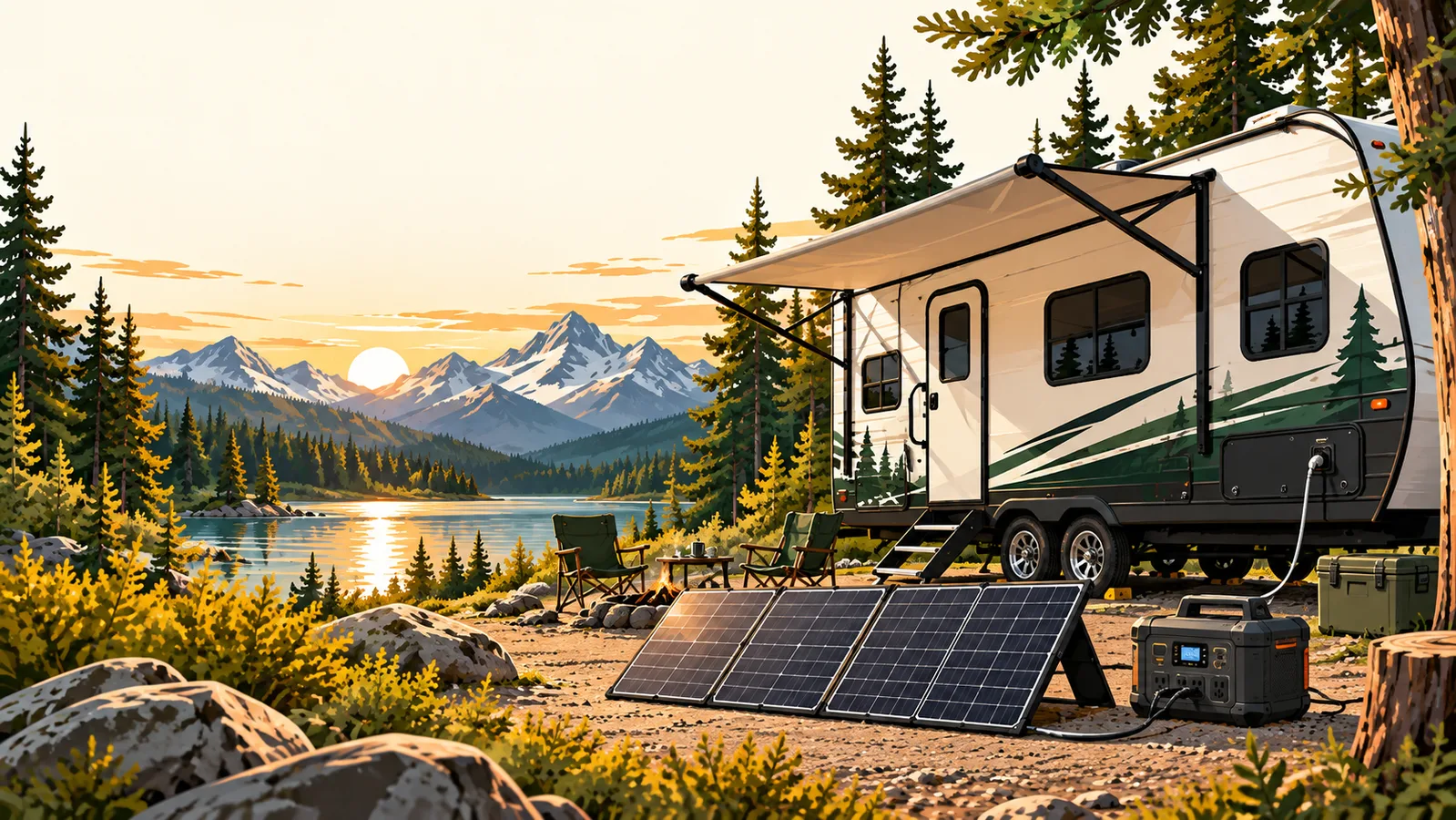
Travel trailer campsite with portable folding solar panels and a power station
BUYING GUIDE · READING & PRODUCT SUGGESTIONSPORTABLE RV SOLAR · CANADA 🇨🇦

Portable solar starts with what you are charging.

A folding panel is only one part of the system. The useful first question is whether you are charging a conventional 12V trailer battery or feeding a portable power station with its own solar input.

✓ Fit before product✓ Canada-first buying paths✓ Commission never determines rank
QUICK ANSWER

Choose portable solar by the charging target: battery-direct setups need a compatible charging path, while power stations must stay within their solar-input voltage and current limits.

Best for

✓ Campers spending meaningful time without hookups

✓ Owners who know their battery type or power-station input limits

✓ People who want portable charging without committing to a roof installation

Skip or verify first if

• You camp almost entirely on serviced sites and have no off-grid power problem

• The panel voltage/current or connector path is unknown

• You are assuming a wattage number alone proves compatibility

Check product fit for my trailer →
TRAILERSTEAD VERDICT

For a conventional 12V trailer battery, a suitcase that already includes a suitable charge controller is the simpler starter path. For a power station, match the panel to that device's solar-input limits and connector path.

  • ✓ Battery-direct charging needs a compatible controller.
  • ✓ Power stations have their own voltage/current limits.
  • ✓ Panel wattage alone does not prove system compatibility.
PRODUCT SUGGESTIONS

What Trailerstead would look at first.

Researched assessments of published product specifications, not hands-on tests. Use the fit notes and source links before buying.

RESEARCHED OPTION
200W N-Type solar suitcase kit with Voyager 20A PWM controller
Renogy

200W N-Type solar suitcase kit with Voyager 20A PWM controller

The suitcase includes a controller, reducing the number of separate charging components a beginner has to select.

Fit checkConfirm the complete panel-to-controller-to-battery path; do not assume power-station compatibility.
RESEARCHED PRODUCT · NOT HANDS-ON TESTEDModel / variant: RNG-KIT-STCS200DC-VOY20-CA

Tradeoff: Verify battery chemistry, controller settings and polarity. Rated output is not a daily-energy guarantee.

Check fit: Confirm the complete panel-to-controller-to-battery path; do not assume power-station compatibility.

Source showed unavailable/backordered when reviewed. Check restock timing; Canadian territorial shipping restrictions apply.

View exact product at Renogy Canada ↗ Non-affiliate product linkSource reviewed 2026-10-28. Price, stock and shipping must be confirmed with the retailer.Product specifications source ↗
RESEARCHED OPTION
NextGen 220W portable solar panel
EcoFlow

NextGen 220W portable solar panel

A folding 220W panel offers portable charging when its electrical specifications match the device you already own.

Fit checkManufacturer lists MC4, 21.5V open-circuit voltage and 12.4A short-circuit current; verify device limits and the required cable.
RESEARCHED PRODUCT · NOT HANDS-ON TESTEDModel / variant: NextGen 220W · monofacial

Tradeoff: This is a panel, not a complete battery charger. A separate suitable controller is required for direct trailer-battery charging.

Check fit: Manufacturer lists MC4, 21.5V open-circuit voltage and 12.4A short-circuit current; verify device limits and the required cable.

View exact product at EcoFlow Canada ↗ Non-affiliate product linkSource reviewed 2026-10-28. Price, stock and shipping must be confirmed with the retailer.Product specifications source ↗

Trailerstead ranks fit and usefulness independently of commission. Useful non-affiliate product links are included and labelled. Paid affiliate links, when present, are disclosed separately.

Battery-direct versus power-station solar

These are different jobs. A trailer battery needs a safe charge path that respects battery chemistry and charging requirements. A power station usually contains its own controller, so the panel has to fit the station input instead.

Why 200W is a useful starter class

Around the 200W class, portable panels can make a meaningful contribution without automatically becoming a large roof-mounted project. Real output still varies with sun angle, shade, weather and charging losses.

What to verify before buying

Check the battery chemistry or power-station input specifications, connector polarity, open-circuit voltage, current limits and whether any required adapter or controller is included. Trailerstead treats those checks as more important than the logo on the panel.

QUICK ANSWERS

Questions owners ask before buying.

How much portable solar do I need for an RV?

Start with your daily energy use, battery capacity and charging target. A panel wattage recommendation without those details can be misleading because available sun and system losses vary.

Can I connect a portable solar panel directly to an RV battery?

A conventional RV battery generally needs an appropriate solar charge controller in the charging path. Some suitcase systems include one; verify the exact system and battery chemistry.

Can I use any solar panel with a portable power station?

No. The panel must stay within the power station solar-input voltage and current limits and use a compatible connector or approved adapter.

Is 200W of portable solar enough for an RV?

It can be a useful starter class for modest charging needs, but whether it is enough depends on your loads, battery size, sunlight and how long you camp without other charging sources.

YOUR TRAILER CHANGES THE ANSWER

Turn the guide into a personal plan.

Tell Trailerstead what you tow, how you camp and what you already own. We’ll move the most relevant next step to the top.

Get My RV Gear Plan →
FREE OWNER TOOLS

Use Trailerstead after the buying decision too.

Trip Ready, Camp Mode, Season Ready, Maintenance Log, Gear Tracker and Product Fit Checker are free owner tools.

Explore free RV tools →
HELP ANOTHER RV OWNERShare this guide

Send this buying guide to someone comparing RV gear.